Every few months, I spend some time searching for the perfect LED light bulbs for my apartment; the built-in fixture requires 6 candelabra-base bulbs. These are hard to find, but there are a few products catering to this market, so I randomly buy stuff to see if I ever get anything good.
I found some LEDs that claimed to have a high CRI and were brighter than normal, so I took a chance on them. There were a couple legitimate reviews and 5 or more obviously-fake 5 star reviews. The LEDs turned out to be not that good. They were bright, the dimmability was good, and the layout of the internal LEDs was quite unique (corncob style but with some on the top, which is great). But they emitted a very greenish light, which makes them unusable. I have a spectrophotometer so I took a reading of the spectrum and, as you'd expect from the visual appearance, they emit very little red light (and no cyan light, as is the typical emission pattern of low-CRI LEDs).
I wrote a review covering these points, the positives and the negatives, and included the plot of the emission profile. This review was immediately taken down because:
1) Your review should focus on specific features of the product and your experience with it.
2) We do not allow profane or obscene content.
3) Advertisements, promotional material or repeated posts that make the same point excessively are considered spam.
4) Please do not include URLs external to Amazon or personally identifiable content in your review.
In other words: please do not include actual data in your reviews. What Amazon prefers is that the seller buys their own product under a fake name, and then says "5 stars: Great!"
This is probably my last Amazon purchase. I might do a proper write-up and spam it around the Internets and see if I can attract the attention of some higher-ups... but probably not. Instead, I will just shop elsewhere. B&H is way better for electronics anyway, and if you just want shitty LED lights eBay beats Amazon there.
Maybe I will also start buying every LED light I can find and doing proper reviews... but there is no business model there to make my time worthwhile. Reviews only work if you can actually find a product that's good and get people to buy it through your referral link. If every review says "you will hate this product, save your money", there is no way to get funding. So the fake 5 star reviews will continue, and everyone will continue to hate LEDs.
I had a similar experience. I had DLP bulb burn out in less than a year. The original item claimed to have a 1 year warrantee. So I went through ever means possible to find the contact info for the seller to make a claim. Sure enough, there wasn't any. I wrote up a review indicating that it's falsely advertising a warrantee. In no time it was rejected. It seems that Amazon has a policy or practices that makes it really, really hard to post a negative review and not have it rejected.
I had a similar experience. I've shared it before but I'll copy it here:
I've stopped leaving Amazon reviews. Recently I was bored and went through a few bits of network equipment and PC hardware I purchased and reviewed a few of them. 3/6 of the reviews were rejected for being against community guidelines with no reason provided. Even after reading the guidelines it's not clear why they were rejected. I put in effort to describe why something got its rating from me. For example, I discussed the strengths/weaknesses the network equipment. From now on I might leave a star rating, but I'm not wasting time to get a review accepted. I'll leave that to the shills.
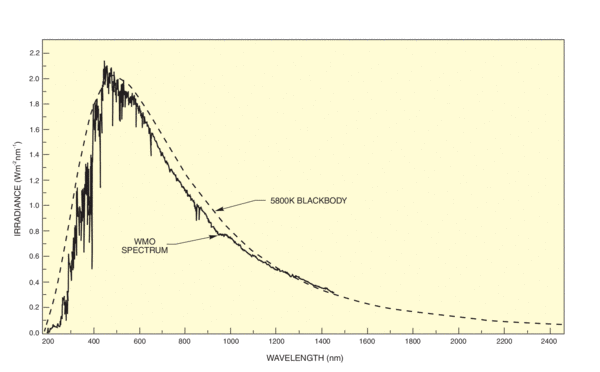
Ikea LEDs are pretty darn good for the price. Also note there is a lot of debate and quandary about the CRI as it applies to fluorescent let alone LED. Basically the CRI as it stands is like your kid coming home with a single grade for their report card, they got a B+. Little do you know they got A's in everything but got an F in earth science. The full spectral power distribution is almost too much information, but you can at least visually see how the sun and near black body radiators like incandescent are similar, whereas not at all the case with fluorescent and LED. LED has the potential to have really good color rendering like those used in the graphic arts, but those bulbs are still expensive and you're not gonna find them in Amazon or Ikea.
But just from a casual, pretty good for the kitchen without making clothes or food sometime look weird? At least the higher lumen MR16 style floods from Ikea are pretty OK. And I also am not worried about them being fakes.
I for one, would love a little chart that shows the power spectrum as well as a black line representing ideal black body output next to the CRI rating. I'm sure a graphic designer can make this prettier (and I think we only care to show the part in the visible spectrum for lights no?). This would show whatever weird spikes or valleys the output might have.
Yes, it would be very nice if people just measured the emission spectrum of their light bulb (compared to incandescent and daylight)... but there is no incentive to do that or for it to be correct.
I agree that CRI is just a number that doesn't have any objective or subjective meaning.
Regarding the specific rather than the meta: I'm very satisfied with the "filament LED" candelabra bulbs from Amazon. I've bought several brands, usually whatever is cheapest. I'm even using e12 to e26 adapters in some fixtures so I can standardize on them. There are lots of comparables on Ebay: https://www.ebay.com/sch/i.html?_nkw=e12+filament+led.
I don't know the actual spectrum, but I like the light quality, and haven't had problems with durability. If you haven't tried this style yet, you should. It's a good design, since it works directly off mains voltage and thus avoids the quick-to-fail heat-sensitive capacitors used in standard LED bulbs: https://en.wikipedia.org/wiki/LED_filament
I haven't ordered anything off of Amazon in a while, and before I do I check other places. I used to not do that, when Amazon was a younger company I bought things from there without much shopping around. I've had problems with counterfeits from Amazon in the past. The problem is that Amazon makes it so seamless to buy something. It's a bit of a hassle to use someone else. I end up always using my PayPal account so I don't have to sign in to all these other outlets.
Seems to be the way forward. TripAdvisor recently sent me a message that hotel X remodeled and this they deleted all (?) old reviews. I'm sure the hotel paid a nice sum for that, from seeing the new reviews not much has changed...
The downvote is fine, but the comment explaining it is excessive. Different people will have different senses of what's relevant vs irrelevant. Although this specific article is about ads on Amazon, I'm personally more interested in the larger question of why/whether Amazon is shooting themselves in the foot with bad policy choices. As such, 'jrockway' was on topic for me.
You're definitely right. This happened to me yesterday and seemed to be relevant to the conversation, as the other top-rated comments were along the lines of "I'm tired of Amazon for additional reason X." Technically this has nothing to do with ads, which doesn't change how I feel about Amazon. I am fine if they want to put ads on their pages. I am not OK if they post fake reviews or filter out negative reviews, though.


Every few months, I spend some time searching for the perfect LED light bulbs for my apartment; the built-in fixture requires 6 candelabra-base bulbs. These are hard to find, but there are a few products catering to this market, so I randomly buy stuff to see if I ever get anything good.
I found some LEDs that claimed to have a high CRI and were brighter than normal, so I took a chance on them. There were a couple legitimate reviews and 5 or more obviously-fake 5 star reviews. The LEDs turned out to be not that good. They were bright, the dimmability was good, and the layout of the internal LEDs was quite unique (corncob style but with some on the top, which is great). But they emitted a very greenish light, which makes them unusable. I have a spectrophotometer so I took a reading of the spectrum and, as you'd expect from the visual appearance, they emit very little red light (and no cyan light, as is the typical emission pattern of low-CRI LEDs).
I wrote a review covering these points, the positives and the negatives, and included the plot of the emission profile. This review was immediately taken down because:
1) Your review should focus on specific features of the product and your experience with it.
2) We do not allow profane or obscene content.
3) Advertisements, promotional material or repeated posts that make the same point excessively are considered spam.
4) Please do not include URLs external to Amazon or personally identifiable content in your review.
In other words: please do not include actual data in your reviews. What Amazon prefers is that the seller buys their own product under a fake name, and then says "5 stars: Great!"
This is probably my last Amazon purchase. I might do a proper write-up and spam it around the Internets and see if I can attract the attention of some higher-ups... but probably not. Instead, I will just shop elsewhere. B&H is way better for electronics anyway, and if you just want shitty LED lights eBay beats Amazon there.
Maybe I will also start buying every LED light I can find and doing proper reviews... but there is no business model there to make my time worthwhile. Reviews only work if you can actually find a product that's good and get people to buy it through your referral link. If every review says "you will hate this product, save your money", there is no way to get funding. So the fake 5 star reviews will continue, and everyone will continue to hate LEDs.